

Job Quality Indicators » Work-Life Balance by Region
<< Back to list of all indicators
Role Interference |
|
Work Interferes with Family |
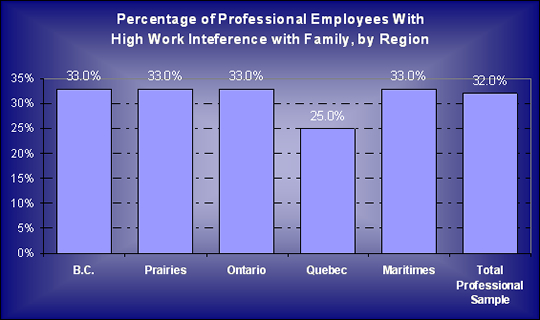
According to the 2001 Duxbury and Higgins study, one-third (32 percent) of professional employees in Canada report that their work responsibilities interfere with their ability to meet their responsibilities at home. Professional employees in Quebec are less likely to say their work demands interfere with their ability to meet family demands - 25 percent report high interference between work and family. |
Employees in Quebec Report |
 |
Source: Where to Work in Canada? An Examination of Regional Differences in Work Life Practices. Duxbury and Higgins (2003). |
Family Interferes with Work |
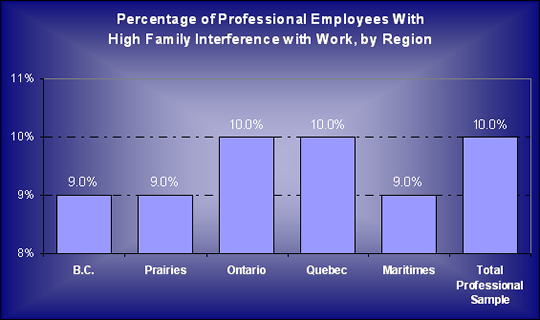
Only 10 percent of professional employees in Canada report high levels of family interference with work. In other words, fewer workers met their family demands at the expense of work commitments. There is little regional variation in this respect, underscoring the prevalence of the idea across Canada that work should take priority over family. |
Little Regional Differences in Family Interference with Work |
 |
Source: Where to Work in Canada? An Examination of Regional Differences in Work Life Practices. Duxbury and Higgins (2003). |
According to Duxbury and Higgins, twice as many Canadian workers gave family priority over work in 2001, as did a decade earlier. They attribute the rise in family interference with work to increased eldercare responsibilities faced by many workers. As the Canadian population continues to age, eldercare responsibilities will no doubt continue to grow as an issue for Canadian workers. |
Additional Charts and Information |