

Job Quality Indicators » Work-Life Balance by Region
<< Back to list of all indicators
Perceived Flexibility |
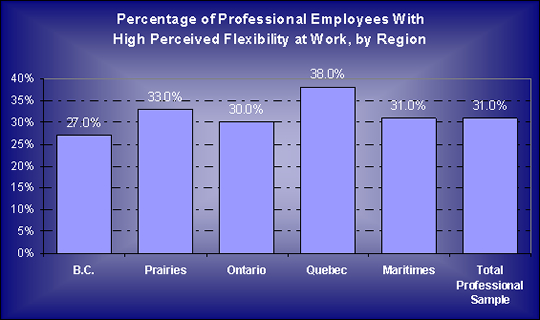
Most employees in Canada generally have set times when they can start and stop work – the typical ‘9 to 5’ type of schedule. However, some employees have greater control over when they can start and stop their workday, many can interrupt their day to attend to non-work related matters, and some can choose to spend some of their time working from home. The flexibility to vary ones’ work time and location can help employees to better balance their work and non-work lives. Duxbury and Higgins used ten questions in their analysis to quantify informal work time and location flexibility. They calculated a total “perceived flexibility” score from these ten items. See Sources and Technical Information for more details. So, does workplace flexibility vary across Canada? As can been seen from the chart below, perceived flexibility among professional employees does indeed vary by region. Professional employees in Quebec are most likely to report having higher flexibility (38 percent) while those in B.C. and Ontario are least likely to report high flexibility (27 percent and 30 percent respectively). |
Professional Employees in Quebec |
 |
Source: Where to Work in Canada? An Examination of Regional Differences in Work Life Practices. Duxbury and Higgins (2003). |
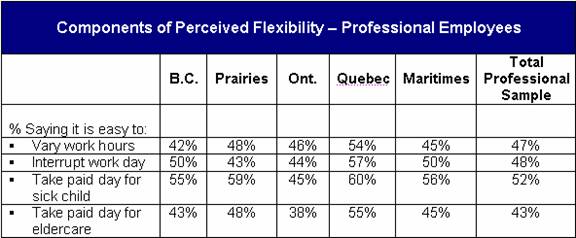
We can get more insight into the “perceived flexibility” scores noted above by looking at some of the key items that make up this measure. As can been seen in the table below, there is a great deal of variation among the regions on specific flexibility measures. However, professional employees in Quebec are more likely to agree that it is easy for them to vary their work hours, interrupt their day and return, take a paid day off to care for a sick child, and to take a paid day off to care for an elderly relative or dependent. It is noteworthy that professional employees in all regions are more likely to say that they can get paid time off to care for a sick child than for an elderly relative or dependent (see table below). This suggests that many Canadian organizations are still not providing enough support for employees with eldercare responsibilities, an issue that will only continue to grow with the ageing of the baby boomer population. |
 |
Source: Where to Work in Canada? An Examination of Regional Differences in Work Life Practices. Duxbury and Higgins (2003). |
Additional Charts and Information |