

Job Quality Indicators » Schedules
<< Back to list of all indicators
Compressed Workweek |
Canadian workers place high priority on having flexibility in their work schedules. One option for providing this is what’s called a ‘compressed work week’. This refers to working extra time each day to reduce the number of days in the workweek, such as four ten-hour days, or an extra half-hour each day with every second Friday off. |
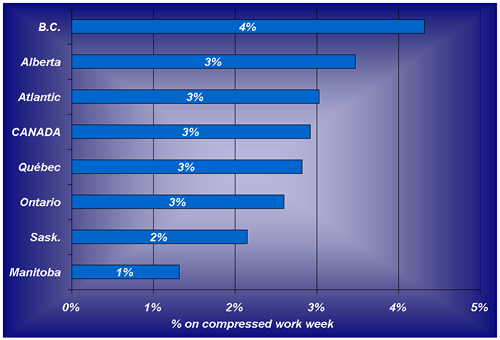
Compressed Workweeks: Rare in All Provinces |
|
Source: Statistics Canada Workplace and Employee Survey (1999) - employee survey. |
As this chart shows, such arrangements are rare, with barely 3 percent of Canadian employees working a compressed workweek. This share is somewhat higher in British Columbia and somewhat lower in Saskatchewan and Manitoba. |
By Size of Workplace |
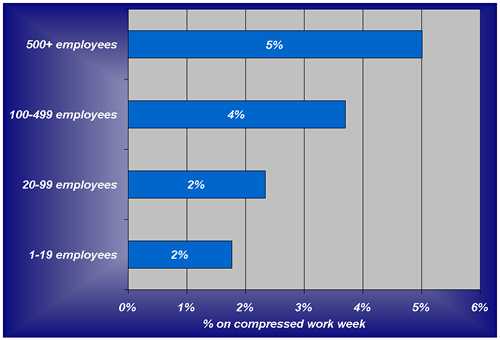
Compressed Workweeks: More Frequent in Larger Firms |
 |
Source: Statistics Canada Workplace and Employee Survey (1999) - employee survey. |
Compressed work weeks are most prevalent in large workplaces (those with 500 or more employees), where 5 percent of employees work longer days to earn an extra day off. Larger workplaces may have the staffing flexibility needed to accommodate employees who prefer such a schedule. As well, shift-work operations sometimes use longer workdays in order to give workers more time off weekly – a way of lessening the negative impacts of shift schedules. |
By Industry |
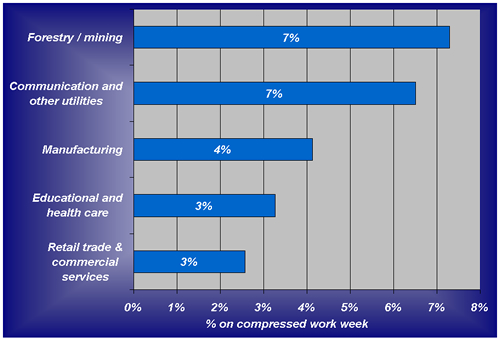
Compressed Workweeks: Most Common in Forestry and Mining |
 |
Source: Statistics Canada Workplace and Employee Survey (1999) - employee survey. |
Compressed workweeks are most common in the fields of forestry and mining, followed closely by communications and other utilities. |
By Outcomes
|
Compressed workweeks offer numerous potential benefits to employers and employees. An extra day off work may decrease childcare expenses, reduce commuting time, and free up time to spend with family and friends. For employers, compressed workweeks may increase morale and productivity, decrease absenteeism and operating costs, and provide longer blocks of time during the day for projects. On the other hand, finding child care to match a compressed work schedule may be difficult since care may be needed for a 10 or 12 hour day, rather than an 8 hour day. Working long hours also cuts into the evening, thus leaving less time for family and personal activities. Longer work days may also be physically and mentally draining, to an extent that an extra day off does not make up for the added fatigue. Finally, compressed workweeks may not be well suited to stressful or monotonous jobs. While more evidence is needed to fully assess the impacts associated with compressed workweeks, it is important to give workers a say over whether or not they want to move to this type of schedule. |
Additional Charts and Information |