

Job Quality Indicators » Schedules
<< Back to list of all indicators
Shift Work |
We live in a 24-hour, seven-day-a-week economy - a ‘round the clock’ world which clearly has an impact on people’s lives. |
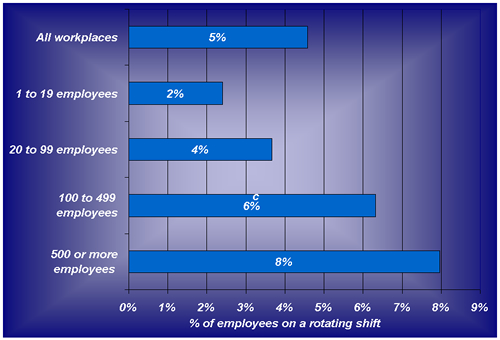
Shift Work: Most Common in Larger Workplaces |
|
Source: Statistics Canada Workplace and Employee Survey (1999) - employee survey. |
Shift work means working outside of the "standard" ‘6 a.m. to 6 p.m. time range. Often such work entails rotating through a series of day, evening or night shifts, sometimes according to a known schedule, sometimes not. This indicator examines rotating shift work. It suggests that about 5 percent of all employees are on a rotating shift. |
By Region |
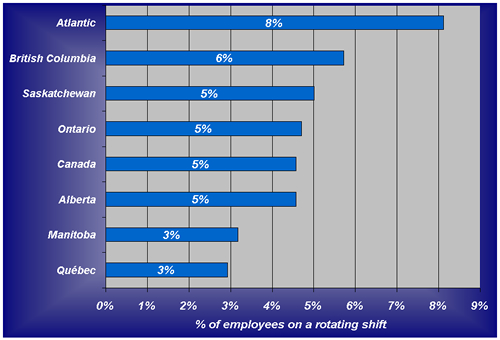
Shift Work: More Than Twice as Common in Atlantic Provinces Than in Quebec |
 |
Source: Statistics Canada Workplace and Employee Survey (1999) - employee survey. |
The share of employees who work on a rotating shift is between 5 and 6 percent in most provinces, and is quite consistent in that respect. However, shift work is slightly more common in the Atlantic region (at 8 percent) and somewhat less common in Manitoba and Quebec. The reasons for these differences are not entirely clear, but most likely reflect regional industrial variation and the proportion of a province’s labour force in service or production facilities that run around the clock. |
By Industry |
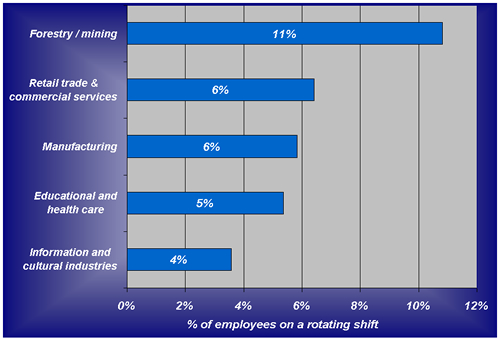
Shift Work: One in Ten Primary Industry Employees Perform Shift Work |
 |
Source: Statistics Canada Workplace and Employee Survey (1999) - employee survey. |
The prevalence of rotating shifts varies noticeably by size of workplace, being three times more common in large workplaces than in small ones. This reflects the fact that large operations, such as manufacturing plants and pulp and paper mills, generally operate 24 hours a day, as do some large public service providers, such as hospitals, police and fire protection services. In terms of industry sectors, we see that rotating shifts are most common in forestry and mining, retail trade and commercial services (e.g. restaurants, shops and bars), and manufacturing. |
By Outcomes
|
Shift work has some advantages for employees. For example, it may provide the flexibility to balance work and family, or combine a job with an educational program. But there are also disadvantages. Night-shift workers frequently complain about lack of sleep or sleep disorders, and the cumulative effect of these problems can take a toll on a shift worker’s health. Some research suggests that rotating shifts are physically stressful because the body’s internal clock is forced to continually adapt to new work-schedules. And psychological stress can arise when rotating shifts disrupt family and social schedules. As consumers and citizens, we seem to like the benefits of a ‘24-7’ economy. But for those who keep it up and running, there can clearly be a downside. While we may not be prepared to give up around the clock services, we could try to minimize the negative impact that shift work has on those who perform it. |
Additional Charts and Information |