

Job Quality Indicators » Pay and Benefits
<< Back to list of all indicators
Merit Pay |
Compensation strategies that link pay to an individuals performance are believed to have a positive effect on an individuals performance at work. Indeed, rewarding special abilities, superior qualities, or expertise that results from training and experience can be a positive factor in motivating employees to further develop, or broaden, their skills. Moreover, a work environment that encourages the continual development of skills and abilities will certainly be more amenable to the creation of flexible of work which are often associated with high performance workplaces. Furthermore, linking pay perks to things like skill development can help promote a learning culture within organizations, a culture which in turn can have positive effects on firm performance, employee retention and on the quality of one’s job. |
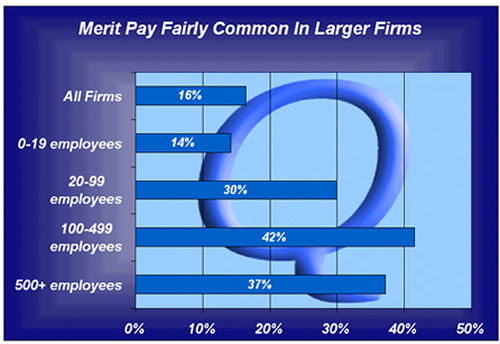
Merit Pay Fairly Common in Larger Firms |
|
Source: Statistics Canada Workplace and Employee Survey (1999) - employer survey. |
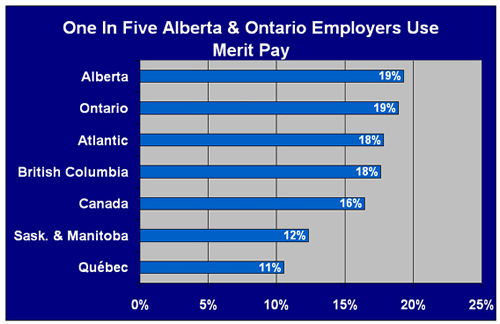
Examining skill and merit pay by province, we see that they are practiced by almost one in five Alberta and Ontario employers, but only one in ten Quebec employers. The notable difference between Ontario and Quebec is peculiar given that the economies of those neighbouring provinces are quite similar. |
By Province |
One in Five Alberta & Ontario Employers Use Merit Pay |
 |
Source: Statistics Canada Workplace and Employee Survey (1999) - employer survey. |
Examining skill and merit pay by province, we see that they are practiced by almost one in five Alberta and Ontario employers, but only one in ten Quebec employers. The notable difference between Ontario and Quebec is peculiar given that the economies of those neighbouring provinces are quite similar. |
By Industry |
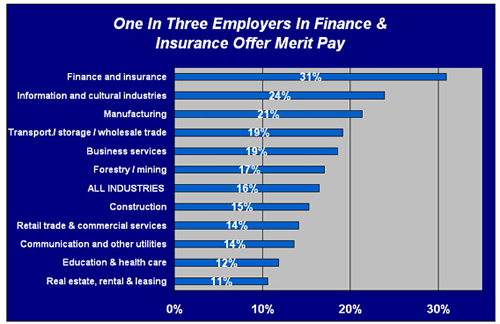
One in Three Employers in Finance and Insurance Offer Merit Pay |
 |
Source: Statistics Canada Workplace and Employee Survey (1999) - employer survey. |
The use of merit and skill based pay varies considerably by industry. Rewarding employees according to skill or merit is quite common in finance and insurance, with close to a third of those employers indicating they compensate employees in such a manner. At the other extreme were education, health care, real estate, rental and leasing employers where less than one in eight firms reported that they made use of such payment schemes. |
Additional Charts and Information |