

Job Quality Indicators » International Comparisons of Job Quality
<< Back to list of all indicators
Annual Hours Worked |
A comparison of 15 of the 17 countries studied (data for Austria or Luxembourg were not available) shows a wide range of annual hours worked per person, from less than 1400 hours in the Netherlands to over 1900 hours in Greece. Canada , with 1791 hours worked on average in 2001, ranks in fourth place. Workers in the U.S. report the second highest average annual hours worked with, 1821 hours in 2001. Data on average annual hours worked per person are not available by gender, age, or employee status of worker. |
Workers in Greece Reported the Highest |
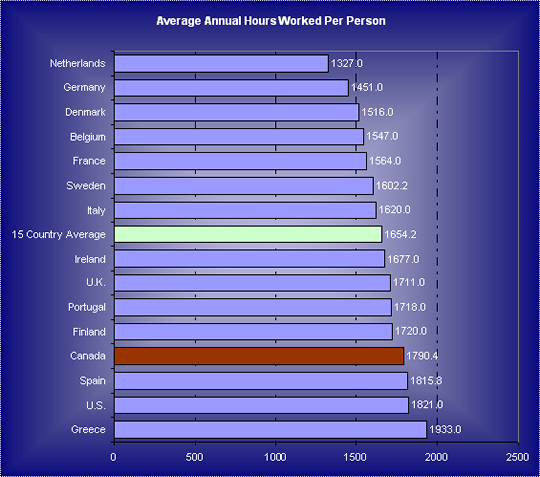 |
Source: OECD Labour Market Statistics – Data, “Average actual annual hours worked per person in employment” - 2001 data. |
Variations in working hours across countries reflect a number of factors, including social conditions, employment practices, and government policies. Some countries in Europe have implemented policies of limiting work hours as a tool to deal with unemployment. France ’s experiment with a 35-hour work week is one example of this strategy. In contrast, the U.S. and Canada have fewer regulations on work hours or use of overtime, which may explain the higher annual hours worked in these countries. |
Indicators |