

Job Quality Indicators » Gender and Job Quality
<< Back to list of all indicators
Outcomes of Computer Use |
In this section, we examine how IT affects the quality of working life in Canada. The intensity of computer use is important because of its potential impact on job quality. Is the intensity of computer use associated with either positive or negative outcomes for job quality? Do women and men experience these outcomes differently? The answers to these questions are presented below. |
Negative Outcomes of Computer Use |
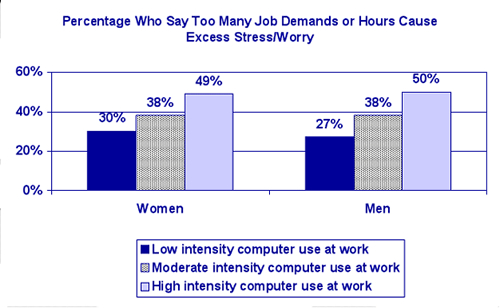
As the chart below shows, intensity of computer use is associated with perceptions of increased workload and the potential for work-family spillover. Overall, high intensity users of computer technology are more likely than other workers to experience stress or worry due to workload and to take their work home with them. Close to half of both women and men who are high intensity computer users report that too many demands or hours of work cause them stress and worry. With respect to stress, it appears that the impact of the IT revolution is gender-blind. |
Intensive IT Use is a Source of Job Stress For both Men and Women |
|
Source: Statistics Canada General Social Survey (2000) as reported by Hughes, Lowe, and Schellenberg (2003). |
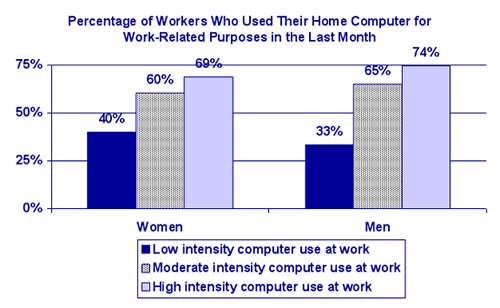
A similar pattern is evident when we consider use of home computers for work-related purposes. High intensity users of computer technology are more likely to report spillover of work into the home. This is equally true for women and men. As shown in the chart below, 74 percent of men and 69 percent of women who are high intensity computer users report that they have used their home computer for work related purposes. |
IT Facilitates Spillover of Work Into Home For Women and Men |
 |
Source: Statistics Canada General Social Survey (2000) as reported by Hughes, Lowe, and Schellenberg (2003). |
It is noteworthy that the majority of individuals who use a home computer for work are not telecommuters, so the chart above reports hours worked at home over and above the workers’ regular schedule. These results could have serious implications for employers and employees. Duxbury and Higgins (2001) report that employees who experience high levels of role overload and work-family conflict tend to be less committed to their employer, less satisfied with their jobs, more likely to report job stress, more likely to be absent from work, and more likely to consider quitting their job than other employees. |
Positive Outcomes of Computer Use |
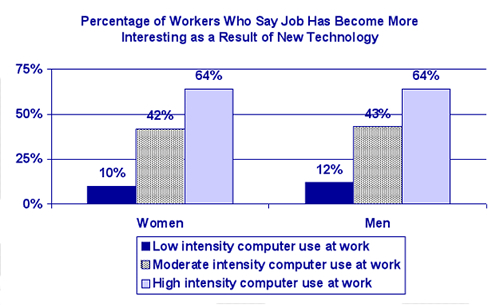
While high intensity computer use may bring increased workloads and job demands, it may also have a positive impact in other areas of job quality. High intensity computer users are more likely to report having learned new skills and to feel their work has become more interesting as a result of technological change. As the chart below indicates, intensity of computer use is positively associated with perceptions of increased skill use and interest on the job for both women and men. |
New Information Technology Is Associated With Increased Skill Use and Interest on the Job for both Women and Men |
 |
Source: Statistics Canada General Social Survey (2000) as reported by Hughes, Lowe, and Schellenberg (2003). |
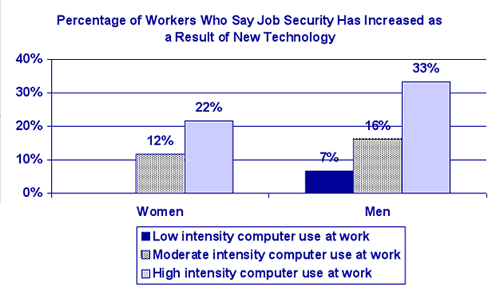
Are Canadian workers more vulnerable to job loss as a result of technological change, as some have speculated? Of workers who report that their job has been somewhat or greatly affected by technological change, 40 percent say their job security has remained the same. A further 14 percent reported technological changes had a positive effect on job security, while only 5 percent perceived a negative effect. As the chart below shows, the perceived positive effects of technological change on job security are most widely reported by high intensity users of computer technologies, but more so for men than women. These data suggest that job security is the only outcome of technological change where we find notable gender differences. |
High Intensity Users of IT Most Likely to Report Greater Job Security, More So For Men than Women |
 |
Source: Statistics Canada General Social Survey (2000) as reported by Hughes, Lowe, and Schellenberg (2003). |
Additional Charts and Information |