

Job Quality Indicators » Gender and Job Quality
<< Back to list of all indicators
Highly Valued Job Features |
What do women and men want in a job? Participants in the CPRN-EKOS Changing Employment Relationships Survey were asked “If you were looking for a new job today, how important would the following be to you?” in relation to 17 job characteristics, and asked to rank them on a scale ranging from 1 (“not at all important”) to 5 (“very important”). As the chart below shows, non-monetary aspects of a job are highly valued by Canadian workers. It is interesting to note that being treated with respect and having work that is interesting tops the list of items that workers see as most important in a job. Items such as good pay and benefits come further down the list. Employers who are able to meet these expectations will be in a better position to attract and retain highly skilled workers. |
Employees Rank Many “Softer” Job Characteristics Ahead of Pay and Benefits |
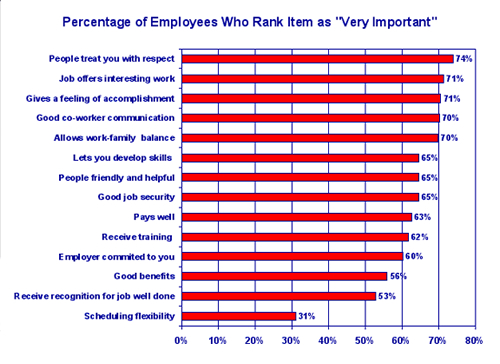 |
Source: CPRN-Ekos Changing Employment Relationships Survey. Paid employees only (n=2118). |
Gender Differences in Highly Valued Job Features |
Are there key differences in what men and women value in a job? Although there are some common issues that are clearly important to all employees (men and women), women place more value on supportive workplace climates. As shown in the chart below, women value respect, communication, recognition, work-family balance, and co-worker relations more highly than men. These results suggest that employers need to take into account the different implications for male and female employees of their human resource policies. HR initiatives that foster a positive and supportive climate among employees will likely be received well by female employees in particular. On the flip side of this, if respect, recognition, and communication are lacking in an organization, women may be the first group of employees to become disengaged. |
What Female and Male Employees Consider 'Very Important’ in a Job |
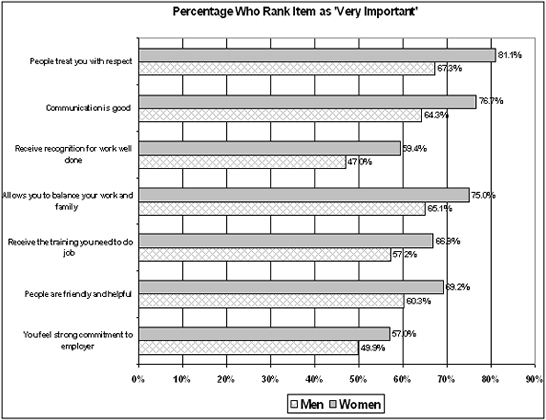 |
Source: CPRN-Ekos Changing Employment Relationships Survey. Paid employees only (n=2118). Reprinted from Hughes, Lowe, and Schellenberg (2003). |
Additional Charts and Information |