

Job Quality Indicators » Communications and Influence
<< Back to list of all indicators
Employee Participation |
We all like to have a say in decisions that affect our job. This give us a sense of control over our work life – that we have some meaningful influence over how we do our work and under what conditions. So it's not surprising that workers who participate in workplace decisions typically feel less ‘stressed out’ on the job. What’s more, when workers are provided opportunities to give input to management, this increases the flow of good ideas and suggestions. So the organization can benefit from greater employee participation too. |
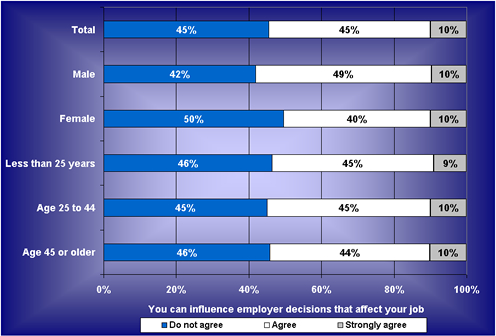
Workplace Influence: Almost Half Say They Lack It |
|
How much influence do Canadian employees have? As the above chart shows, a slight majority have opportunities to influence workplace decisions. Specifically, 55 percent agree or strongly agree with the statement ‘you can influence employer's decisions that affect your job’. Yet it’s probably true that this influence is quite limited, considering that only 10 percent of employees ‘strongly agree’ with the statement. And furthermore, 45 percent report having little or no influence over decisions that affect their job. Note the gender gap here: women are somewhat more likely than men to lack this kind of workplace influence. |
By Size of Workplace |
Workplace Influence: Employee Input Strongest in Smaller Firms |
 Source: CPRN - EKOS Changing Employment Relationships Survey (2000). |
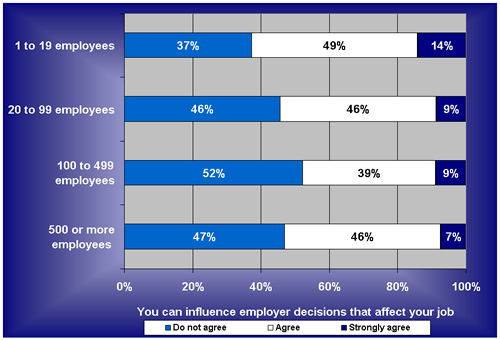
Perceptions of influence vary somewhat by size of workplace. As shown above, employees in larger workplaces are somewhat more likely to say they cannot influence decisions affecting their job than employees in small workplaces. Small firm employees are likely to have more direct contact with their employer and hence feel they have a greater influence in workplace decisions. |
By Employment Type |
Workplace Influence: Majority of Self-Employed Feel They Have Influence |
 Source: CPRN - EKOS Changing Employment Relationships Survey (2000). |
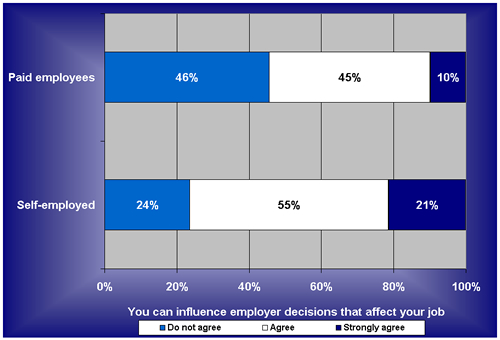
Many people have become self-employed with the goal of gaining greater independence in their daily working life. Evidence suggests that most succeed in this respect. When self-employed individuals are asked if they can influence client decisions that affect their job, 55 percent agree that they can, and another 21 percent strongly agree. In short, self-employed individuals are far more likely to feel they can exercise control over their work life than paid employees. Clearly, one of the major advantages of "being one’s own boss" is the autonomy and independence it provides. |
By Occupation
|
Workplace Influence: Managers Report Most Influence |
 Source: CPRN - EKOS Changing Employment Relationships Survey (2000). |
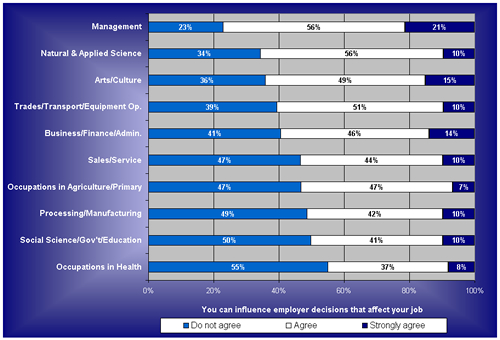
Influence varies markedly by occupation. The chart above ranks occupations according to the extent to which workers in each perceive they can influence workplace decisions. It is interesting to note which occupations are at the top and the bottom in terms of perceived influence. While more than three in four managers agree or strongly agree that they can influence decisions affecting their job, this is true for fewer than one in two (non-management) workers in health occupations. This makes sense, given the amount of workplace restructuring in health care imposed from the top down, and the fact that managers generally have more autonomy than others to make decisions. |
By Outcomes |
Workplace Influence: Workers With Little Influence Less Satisfied With Job, |
 |
Source: CPRN - EKOS Changing Employment Relationships Survey (2000). |
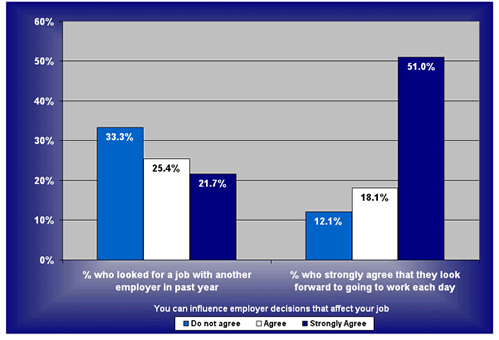
The ability to influence workplace decisions is associated with important outcomes. When asked, a vast majority of workers indicate that the quality of their services and products would improve if only they had more say in workplace decision making. As illustrated above, individuals who have little influence in workplace decisions are more likely to look for work with another employer – an important point for employers concerned about finding and keeping workers. As the chart also indicates, increased influence is associated with improved job satisfaction. |
Additional Charts and Information |