-corpo2.jpg)

Indicateurs de qualité des emplois » Schedules
<< Retour à la liste de l’ensemble des indicateurs
Flexible Hours |
Most employees in Canada have set times when they start and stop work. Typically this is a ‘9 to 5’ or ‘8 to 4’ type of schedule. But some employees have greater control over when they start and stop their workday. The concept of ‘flextime’ means that while an employee must work a certain number of core hours they can vary their start and stop times. In short, these individual work a full week, but don’t ‘punch the clock’ in a rigidly defined way. |
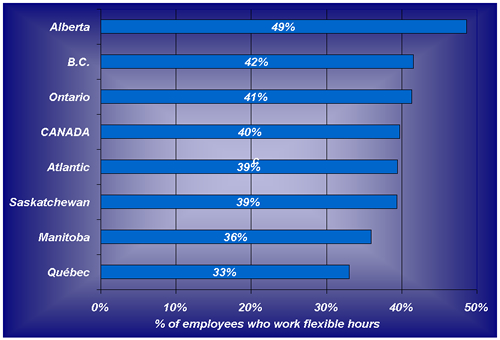
Flexible Hours: Major Difference Between Alberta and Quebec |
|
Source: Statistics Canada Workplace and Employee Survey (1999) - employee survey. |
As shown in the chart above, 40 percent of Canadians work on a flexible schedule. Alberta has the largest share of employees on flextime, at almost 50 percent, compared with only 33 percent in Quebec. It is interesting to note that the ‘long work hours’ and ‘unpaid overtime’ indicators show Alberta leading the country in these respects as well. So it seems that workers in that province are most likely to work long, and often unpaid hours, but have some flexibility as to how these are scheduled. Still, more information is needed to determine whether those people who work long hours and the same people who work on a flexible schedule. |
By Size of Workplace |
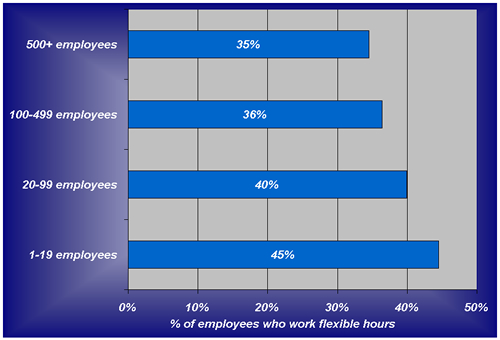
Flexible Hours: Flexible Hours More Common In Smaller Firms |
 |
Source: Statistics Canada Workplace and Employee Survey (1999) - employee survey. |
The opportunity to exert some control over the start and end of the workday is associated with workplace size. Employees in large workplaces are least likely to be employed on a flexible schedule, while those in small workplaces are most likely. This probably reflects the reliance on formal written policies in large firms, and informal practices commonly found in smaller firms. |
By Industry |
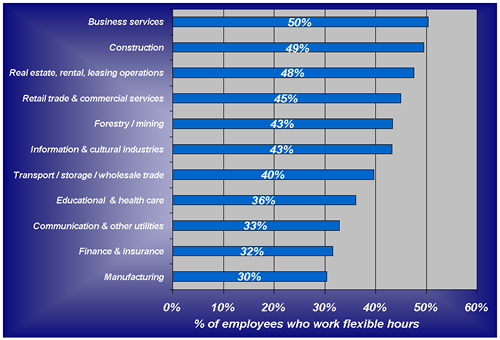
Flexible Hours: Considerable Industry Differences |
 |
Source: Statistics Canada Workplace and Employee Survey (1999) - employee survey. |
Firms in some industries are limited in the extent to which they can offer scheduling flexibility. For example, large industrial workplaces, such as manufacturing plants and pulp and paper mills, require tight scheduling given the continuous nature of production and the use of shift work. One would therefore expect flexible schedules to be rare in such industries. Similarly, large financial institutions need people to start their day at specific times to better serve the public. As shown above, flexible schedules are least common in these industries. |
By Outcomes
|
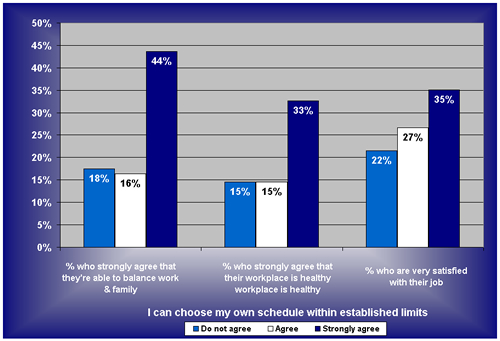
Flexible Hours: Related to Work / Life Balance, Healthy Workplaces and Job Satisfaction |
 |
Source: Statistics Canada Workplace and Employee Survey (1999) - employee survey and CPRN - EKOS Changing Employment Relationships Survey (2000). |
Flexible schedules give individuals more control over their work lives. So it is not surprising that this form of flexibility is positively associated with balancing work and family, as the chart above shows. Beyond this, higher levels of job satisfaction are associated with increased control over one’s time at work. Employees on flextime are also more likely to rate their workplace as a healthy environment. In summary, having flexible schedules is an important feature of a high quality work environment. |
Additional Charts and Information |