-corpo2.jpg)

Indicateurs de qualité des emplois » Communications and Influence
<< Retour à la liste de l’ensemble des indicateurs
Information Sharing |
We’ve all heard major employers, or leading management consultants, advocate ‘employee Sharing information is what good communication in the workplace is all about. A CPRN study, What’s A Good Job?The Importance of Employment Relationships, found that better communication is what employees would most like to see in their relationship with their employer. The same study also linked good communication to three other dimensions of employment relationships: trust, commitment and employee influence. Improved communication is not overly difficult to achieve. As one participant in the What’s A Good Job? study noted, all that is really needed of management is to "once a month sit down and discuss current issues on the basics of the business with everyone." |
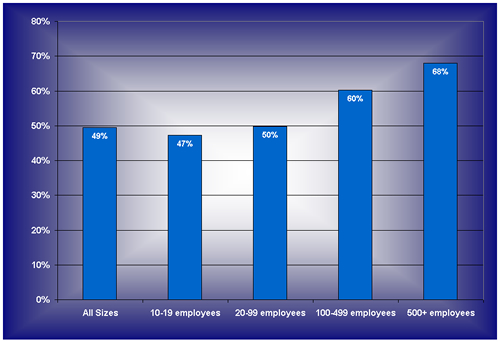
Sharing Information: More Common In Larger Firms |
|
Source: Statistics Canada Workplace and Employee Survey (1999) - employer survey. |
As the chart above shows, many Canadian companies already have some formal way to share information with their employees. Indeed, half of Canadian workplaces with more than 10 workers formally share information with their employees, with larger firms even more likely to do so. In fact, 60 percent of medium-sized firms (100 to 499 employees) have a process for sharing information, and more than two thirds of large firms (500 or more employees) do. However, while these figures tell us about how many workplaces share information, they do not tell us about the quality of the information being shared with non-managerial employees. It may be the case that management is more willing to share information on upcoming events or broad corporate strategies than on financial performance, since that latter could influence labour’s position in collective bargaining. Note also that this information pertains to "formal" ways of information sharing – such as regularly scheduled meetings, a staff newsletter, a company ‘intranet site,’ regular emails or memos from senior management. In small firms, the sharing of information may occur on an informal basis, such as casual discussions between employers and employees as they work alongside each other. Even in large firms, the absence of a formal mechanism for information sharing simply raises questions about the extent to which various informal channels of communication are relied upon. |
By Region |
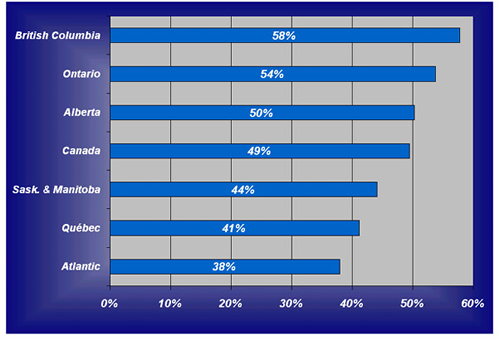
Sharing Information : Reported to be Most Common in BC and Ontario |
 |
Source: Statistics Canada Workplace and Employee Survey (1999) - employer survey. |
There are fairly large regional differences in the occurrence of formal information-sharing practices. While such practices are quite widespread in British Columbia (58 percent of workplaces), they are far less common in Quebec and the Atlantic provinces (at 41 and 38 percent respectively). The twenty percentage point difference between B.C. and the Atlantic provinces is striking. |
By Industry |
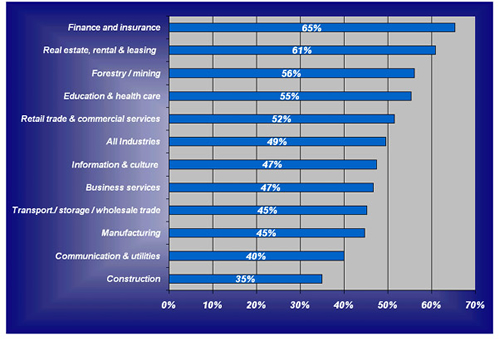
Sharing Information: Fairly Common in Finance and Insurance, Relatively Rare in Construction |
 |
Source: Statistics Canada Workplace and Employee Survey (1999) - employer survey. |
As the chart illustrates, there are also differences in the prevalence of formal information sharing by industry. Such practices are most common in the finance and insurance sector, followed by real estate, forestry and mining, and education and health care. Formal information sharing is rarest in the construction and communications and utilities industries. |
By Outcomes
|
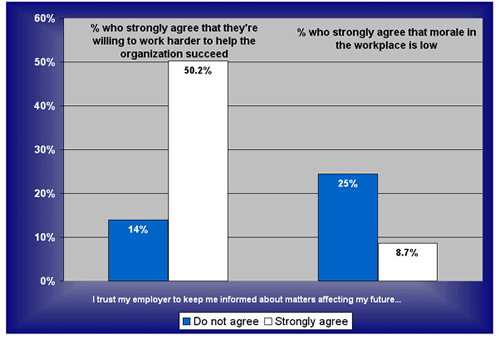
Sharing Information: Frank Communication Associated With Employee Motivation and Morale |
 |
Source: Statistics Canada Workplace and Employee Survey (1999) - employer survey and CPRN - EKOS Changing Employment Relationships Survey Questionnaire (2000). |
Providing staff with information about organizational changes, new technology, strategic directions and changing market conditions is not an expensive proposition for employers. Such information is highly valued by employees and has important consequences. As shown below, employees who trust their employer to keep them informed about matters affecting their future are far more likely to feel committed to the employer and to work even harder if that is necessary for the well-being of the organization. Effective communication is also related to higher levels of workplace morale. |
Additional Charts and Information |