-corpo2.jpg)

Indicateurs de qualité des emplois » Communications and Influence
<< Retour à la liste de l’ensemble des indicateurs
Employee Influence as a Workplace Strategy |
We’ve all heard major employers, or leading management consultants, advocate ‘employee empowerment’. The thinking behind this is that workers who have a say in workplace decisions will be more satisfied, committed, and engaged in their work – and at the end of the day, will do a better job. Indeed, a growing number of studies report a link between employee participation, on the one hand, and firm performance on the other. Let’s look, then, at how far Canadian employers have gone in ‘empowering’ their workforce. |
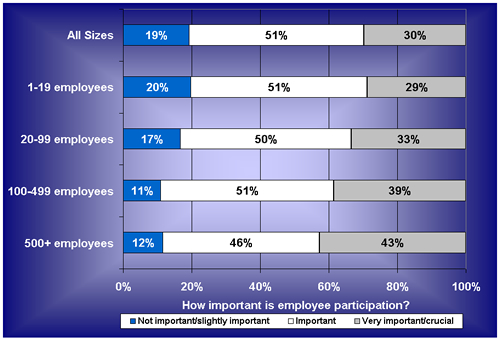
Empowering Employees: A Minority of Employers Say It's Very Important |
|
This chart shows that in spite of the rhetoric about greater employee participation, less than one-third of workplaces in Canada view increased employee participation as a ‘very important’ or ‘crucial’ part of their overall business strategy. About one-half of workplaces say increasing employee participation is "important", while the remaining fifth say it is of little or no importance. Large workplaces of 500 or more employees appear to place greater emphasis on employee participation, with 43 percent indicating that increasing participation is a very important or crucial part of their business strategy. In sharp contrast, only 29 percent of small workplaces gave it the same priority. |
By Industry |
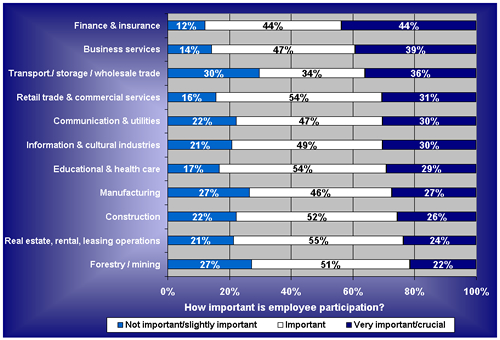
Empowering Employees: Deemed Most Important by Managers in Finance and Insurance |
 |
Source: Statistics Canada Workplace and Employee Survey (1999) - employer survey. |
Firms in different sectors of the economy place varying degrees of emphasis on employee participation. As shown below, 44 percent of workplaces in finance and insurance rate increased employee participation as a very important or crucial part of their business strategy. Employee participation is also rated very highly in workplaces that provide business services. In fact, with the exception of transportation, storage, wholesale trade, manufacturing and mining, 75 percent of most industries rate increasing employee participation as important or very important. |
By Region |
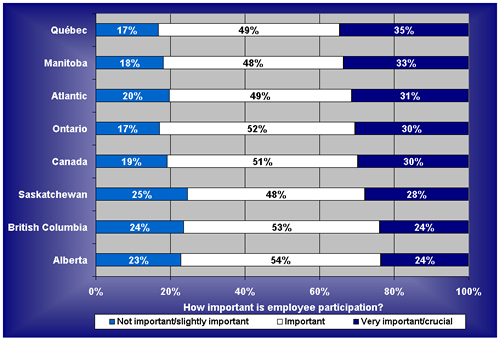
Empowering Employees: Quebec and Manitoba Employers Most Open to Employee Participation |
 |
Source: Statistics Canada Workplace and Employee Survey (1999) - employer survey. |
There are also some interesting differences across the regions of the country. While over one-third of workplaces in Quebec rate increased employee participation as very important or crucial, this is the case for less than one-quarter of workplaces in Alberta. No doubt, a wide range of factors underlies this regional variation. One factor is the type of industries found in different regions. Compared with Quebec, a large share of workplaces in Alberta are involved in industries such as mining, an industry in which increased employee participation ranks quite low as a business strategy. |
By Outcomes
|
Judging from our indicators on employee participation as reported by workers, there are obvious benefits to encouraging increased employee participation. The message for employers is that greater employee participation in decision making has a good chance of paying off in terms of lower turnover and job satisfaction – as well as other outcomes that have not been examined here. A recent American study reports that workers who express satisfaction with the extent of their involvement at the workplace have high levels of job satisfaction, positive assessments of labour-management relations, and positive assessments of workplace morale. |
Additional Charts and Information |